Political Armageddon

Political Armageddon

by Ralph Benko

Dedicated to Jamie Raskin, Congressman, Maryland’s 8th District

The collapse of the metanarrative caused by the Cold War’s end eliminated the framework that gave meaning to politics from 1947 until 1991 and for some time thereafter. As reported in 1988 by the LA Times:

Georgi Arbatov

“’Our major secret weapon is to deprive you of an enemy,’ said Georgi Arbatov, director of the Soviet Academy of Sciences’ Institute for U.S and Canada Studies.”

The LA Times continues:

“’Moscow no longer wants to wear the black hat,’ Arbatov said during a frank speech before Soviet and U.S. scientists at the University Club.

“’It’s historical, it’s human, you have to have an enemy,’ he said. ‘So much was built out of this role of the enemy. Your foreign policy, quite a bit of your economy, even your feelings about your country. To have a really good empire, you have to have a really evil empire.’”

Call what now besets us Arbatov’s Revenge. It goes a long way toward explaining the currently incomprehensible state of our national politics. Our post-WWII enemy vanished, anti-climactically, imploding the armature of meaning that sustained us.

Our very human need for an enemy has conjured us a new one. Unfortunately, it is a dysfunctional one, a political Armageddon converting our domestic political rivalry into guerre a outrance partisanship. With that comes a Little Dark Age.

Armageddon, of course, was the ultimate battle prophesized in the Book of Revelation, the dystopian apocalyptic caboose to the Christian Scriptures. As summarized colorfully and in good doctrinal fashion at the Billy Graham website:

“The armies of the world will focalize on a point known as Armageddon, the Mount of Megiddo, and there the final world conflict will take place. The extent of this conflict is indicated in the ninth chapter of Revelation, where the army that is to cross the Euphrates River is described; and in that chapter the immensity of this final world war is carefully described. … We are aware of the shuffling of the stage in preparation for the greatest battle of all time that will certainly take place in the years ahead. The crisis of the present hour should shatter the optimism concerning human nature of every person listening to my voice.”

This Christian projection of such an ultimate battle isn’t unique.

The Hindu Bhagavad Gita, the climax of the epic Mahabharata, recounts the comparably monumental Battle of Kurukshetra wherein two clans fight for hegemony to the point of mutual near-annihilation. Pivoting to Greece there is the 10-year siege and conquest of Troy as recorded for posterity by Homer. Moving from Greece to Rome one recalls the utter destruction of Carthage in 149 BC in the Third Punic War. And lest I forget thee … let us call to mind the destruction of Biblical Israel by the Neo-Assyrians, the destruction of the Kingdom of Judah by the Babylonians, and the razing of Jerusalem by the Romans.

Apocalypse then!

Arbatov was shrewd: “It’s historical, it’s human, you have to have an enemy. …” Even the apolitically optimistic technocrat Bill Gates observed, at TIME Magazine, that “It’s human nature to zero in on threats: evolution wired us to worry about the animals that want to eat us.”

We made a brief post-millennium detour on 9/11, an attack we understandably mistook for Pearl Harbor II. On September 10, 2001 America was on a hair-trigger after a century of world wars, hot and cold. We were vulnerable to what Nicholas Lemann, reviewing the movie Vice in the New Yorker, astutely called “threatism.”

America made a bipartisan decision to dub “Terrorism” the new Enemy. In reality Al Qaeda (and its successor Daesh) turned out to be fatally weak political death cults seeking to restore the Caliphate, not existential threats like the Nazis and Commies.

Upon that flimsy metanarrative we wasted trillions of dollars, spilled oceans of blood, engaged in the longest and possibly least gratifying war in American history damaging or destroying several states in the process. Adieu, Libya! Eventually Terrorism, as horrific and melodramatic as it is, became transparently insufficient a villain to sustain a credible new metanarrative.

So, we pivot to demonizing one another.

As an aside, one can trace the evolution of the American narrative from Hollywood’s output. In the ‘30s you had frontier Westerns with heroic sheriffs fighting brutal outlaws. The ‘40s gave us heroic soldiers fighting evil Nazis and imperial Japanese troops. The ‘50s, ‘60s, and ‘70s gave way to heroic fights against Communist agents. All gave way to noir anti-heroes, dystopian futures, Imperial Storm Troopers and, eventually, Zombies.

A great, non-phantasmagorical enemy is now hard to find. Meanwhile, what really happened down here under the rockets’ red glare?

The left and the right, embodied in the two national political parties, dubbed one another mortal enemies instead of spirited rivals. Back in the more innocent age of my youth nobody knew and nobody cared whether a character played by John Wayne was a Democrat or a Republican. The metanarrative of fighting Western outlaws or the Nazis or the Commies rendered party affiliation irrelevant.

Fast forward. The WWII and Cold War narratives collapsed. In their place our politicos weaponized the instruments of politics previously designed, however imperfectly, to resolve our social and economic problems. Our candidates and elected officials beat their ploughshares into swords and used them, and are using them, to injure their political rivals rather than to promote the general welfare.

Apocalypse now!

But endless outrage turns tedious.

There are signs of Armageddon fatigue setting in.

Meanwhile, over the past decade I appropriated for myself the exorbitant privilege of personally engaging with every progressive thought leader who proclaimed a principled openness to cooperation with principled conservatives and open to meeting me. I actually discovered a few actually operating in good faith.

And discovered zero willingness to cooperate by those of the left with real power and money. A comparable truculence is endemic within the right.

I undertook a political odyssey of comparable duration to that of the vastly more polytropic Odysseus. Therein I had the pleasure of encountering almost as many epic supernal beings, metaphorically speaking (and fabulous monsters, names suppressed to protect the guilty), as did Odysseus in Book One of the Odyssey.

Hello Patrick Reinsborough. Joan Blades. Raul Yzaguirre. Larry Lessig. Andy Stern. John Delaney. Jim Turner. Shaul Praver. Debilyn Molineaux. Mary Gaylord. The entourage of the late Saul Alinsky. Several others, not many. What a privilege to get to party with such fabulous enemies! In the course of my quest it proved possible to identify areas of hot political dispute where the left and the right readily could work together without compromising ideology or principle.

Working together, however, is contrary to the ethos of mutual destruction. Thus, to cooperate would be, thematically, at best a non sequitur, at worst treacherous. Our governing mutual purpose is to destroy our political enemies rather than to promote the general welfare. As economist Paul Romer once said (and which subsequently entered the political discourse): “A crisis is a terrible thing to waste.”

Areas which revealed themselves as obviously tractable include: providing affordable, truly universal state-sponsored health insurance; protecting and restoring the ecology; advancing non-carbon-based energy production, storage and distribution; dramatic reduction of gun violence without infringing Second Amendment rights; generating a rising tide of bottoms-up economic growth to lift all boats; restoring merit-based economic equity; slashing world nuclear weapons stockpiles by another order of magnitude; and paving a path to earned citizenship for otherwise law-abiding, tax-paying undocumented aliens.

But as Andrew Fletcher of Saltoun once wrote, “if a man were permitted to make all the ballads he need not care who should make the laws of a nation, and we find that most of the ancient legislators thought that they could not well reform the manners of any city without the help of a lyric, and sometimes of a dramatic poet.”  Today “all the ballads” are about destroying our rival party rather than about what Fletcher called the “right regulation of governments for the common good of mankind.”

An Armageddon metanarrative makes even tactical cooperation for the common good virtually impossible. Strange, but true.

Absent Armageddon, some of the tractable matters would be easier to resolve than others. However, most show the prospect of significant popular support in ways that can be ideologically palatable both to right and left. This declaration may sound implausible, even impossible. In practice, though, it is surprisingly practical.

Doubt it?

The chief propagandist for Supply-Side economics, Jude Wanniski, an editorial writer for The Wall Street Journal, was a self-proclaimed Marxist. The Supply-Side’s political quarterback, Jack Kemp, was a former labor leader as was its premier wide receiver, Ronald Reagan. The man primarily responsible for propelling the reduction of the top marginal income tax rate from 50% to 28% was self-described Democratic Socialist US Senator Bill Bradley. He did so in partnership with center-left leader Democratic Representative Richard Gephart.

Ronald Reagan’s greatest tax-rate cutting triumph got more of its impetus from the left than the right, resulting in a Senate victory margin of 98-2, bringing widespread shared benefit. This is how transformation happens.

On the day Reagan declared for the presidency in 1979 the Dow was at 814.  Adhering to and extending the Supply-Side policy mix propelled it to well over 20,000. As my colleague Peter Ferrara observed in Forbes.com:
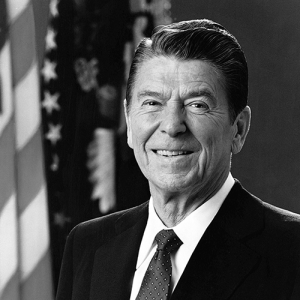
Ronald Reagan

“During this seven-year recovery, the economy grew by almost one-third, the equivalent of adding the entire economy of West Germany, the third-largest in the world at the time, to the U.S. economy. In 1984 alone, real economic growth boomed by 6.8%, the highest in 50 years.  Nearly 20 million new jobs were created during the recovery, increasing U.S. civilian employment by almost 20%.”

Transformation can happen again.

Transformation can happen now.

Transformation just cannot happen under a metanarrative that calls for the extermination of the opposing ideological camp and the eradication of the opposition national political party. This manic ambition is shared by the core of both ideological camps, conservative and progressive, and by both parties.

Over-the-top partisanship, not ideological differences, is the insuperable obstacle.

Being myself an archconservative I would, of course, love to eradicate the left. But let’s get real. That would not necessarily be a great thing. There can be much to learn from a rival’s perspective.

Moreover, the left is more likely to eradicate the right than vice versa. To oversimplify: the left is crazy, not stupid. I have found the converse to be generally true of my beloved right. The left is better at framing issues, thereby gaining enormous tactical advantage. The left has a far better grasp of narrative as more powerful than the right’s beloved argumentation. And the left has the benefit of having assimilated Gramsci and the “long march through the institutions” as phrased by left-wing strategist and martyr Rudi Dutschke.

Advantage: Left!

That said, plenary victory by the left will likely prove Pyrrhic. The left’s political triumph is unlikely to lead to the socialist workers paradises we see in ethnically homogenous Social Democratic (or Christian Democratic) Scandinavia. A plenary progressive victory is more likely to lead to more murder-plagued Chicagos, environmentally tainted Flints, and catastrophic Venezuelas than to Utopias.

The looming public employee pension crisis in blue states and Democratic-controlled municipalities does not bode well. It was not communism, nor socialism, nor well-meaning government aid programs that dramatically reduced dire world poverty during my lifetime to less than 10% of the world’s population. It was free enterprise.

Even assuming naïve idealism, rather than bait-and-switch cynicism, in most rank-and-file leftists, plenary victory would doom to dystopia their utopian romanticism. One yearns for the wisdom of the late Pete Seeger, a socialist icon who at his 90th birthday celebration stated with distinctly conservative overtones: “Normally, I am against big things. I think the world is going to be saved by millions of small things. Too many things can go wrong when they get big. …”

Of course, the left does not share my pessimism. Some people just have to learn the hard way. That said, there is a strong argument to be made – one that can be appreciated by those of good faith on the left — that we are far more likely to bring about positive and sustainable progress through good old Hegelianish Thesis/Antithesis/Synthesis.

My prescription?

There is a better candidate for “Enemy” than one another. Let’s call off the Battle of Armageddon. Follow along.

The real enemy is the Sanctimonious. Sanctimony means making a show of moral superiority. Sanctimony is intoxicating, addictive, and in its own way as dangerous as fentanyl. Many on both the left and right are hooked on it. Let’s name and shame them.

It is possible to create an “Anti-Sanctimony Crusade” to search out and destroy those — on both sides — who have been terminally infected and who serve as vectors to infect the rest of us. The Sanctimonious are the real perps fomenting Armageddon and conjuring this Little Dark Age in which we are stuck.

The handmaiden of sanctimony is dogma. Saul Alinsky was by word and deed a classical liberal, anti-communist, anti-fascist, anti-Big Government figure. He indicted LBJ’s War on Poverty as “political pornography.” He is now thought of as a man of the left mainly because of his lifelong commitment to social justice not because of any connivance with socialism. The right has fumbled the ball on social justice. We used to have firm possession of it. The left has recovered the fumble, if mainly rhetorically, forgetting what Alinsky wrote in Rules for Radicals:

Saul Alinsky

“Dogma is the enemy of human freedom. Dogma must be watched for and apprehended at every turn and twist of the revolutionary movement. The human spirit glows from that small inner light of doubt whether we are right, while those who believe with complete certainty that they possess the right are dark inside and darken the world outside with cruelty, pain, and injustice. Those who enshrine the poor or Have-Nots are as guilty as other dogmatists and just as dangerous. To diminish the danger that ideology will deteriorate into dogma, and to protect the free, open, questing, and creative mind of man, as well as to allow for change, no ideology should be more specific than that of America’s founding fathers: ‘For the general welfare.’”

“Promote the general welfare and secure the blessings of liberty.” It’s right there in the preamble to the Constitution. Could be the cool new Credo.

The indictment of sanctimony and dogma is somewhat different from the call for “transpartisanship” to which the noble Transpartisan Review is dedicated. As I understand it transpartisanship is dedicated to expanding the political analytic beyond “left vs right” by adding a strong dose of “libertarianism vs authoritarianism” into the political algorithm. Follow that with a chaser of pragmatism.

The transpartisan political cocktail emits a heady bouquet of optimism. However, it lacks an Enemy and, thus, lacks a necessary ingredient.

Transpartisanship has merit. That said, it seems to me to present a technocratic solution to an existential problem: the collapse of the old Cold War metanarrative and its replacement with a political Armageddon metanarrative.

Ending the Armageddon demands more than an analytic. We need, rather, an excellent new Enemy!

Hitler and Stalin were authentic Supervillains. They, their allies and their minions gave us a perfect Enemy around which to write our story. Meanwhile let’s get real. Donald Trump and Hillary Clinton do not even come close to Supervillain status. Our yearning for an enemy makes us enthusiastically exaggerate their villainy. The ensuing pudding has no theme. Politics descends to jabberwocky.

Transpartisanship, as I understand it, also overstates the power of ideology in politics. After having walked and stalked the corridors of power for decades I am persuaded that most of those in power, irrespective of party, view policy as a not-very-interesting amenity. Most view ideology as a mere check-the-box nicety.

Idea-people tend to write books and articles and to teach rather than kiss babies, slap backs and run for office. Politicos and government officials tend to be people-people. (Crave a deep dive into the workings of politics as actually practiced? Read George Crile’s Charlie Wilson’s War.)

However, there is a perverse structural dynamic inhibiting putting an end to Armageddon. Unless there were such a sticking point such an inane narrative would have collapsed of its own obvious absurdity years ago. The metanarrative is one of eradicating a loathsome enemy – You! vs Us!  We equate our political rivals with Nazis or Commies.

Thus, it would be politically dangerous for an intrepid political figure to try to call it off. Smacks of connivance or even surrender. Political suicide!

Also, there’s no glory in averting Armageddon. Nobody ever got elected to higher office by preempting a crisis. Political glory comes from waiting for the crisis then resolving it. Voters hardly ever celebrate a politician who preempts a crisis, however deftly. A crisis that never happened does not make the evening news. No drama….

Thus, the political incentives we voters give to our candidates and officials perpetuate this inane Armageddon. Voters simply cannot justifiably blame the pols for avoiding our wrath and seeking our favor.

This is not exactly a new predicament. As the idealistic George Washington wrote in his Farewell Address:

“Let me now … warn you in the most solemn manner against the baneful effects of the spirit of party generally.

“This spirit, unfortunately, is inseparable from our nature, having its root in the strongest passions of the human mind. It exists under different shapes in all governments, more or less stifled, controlled, or repressed; but, in those of the popular form, it is seen in its greatest rankness, and is truly their worst enemy. …

“And there being constant danger of excess, the effort ought to be by force of public opinion, to mitigate and assuage it. A fire not to be quenched, it demands a uniform vigilance to prevent its bursting into a flame, lest, instead of warming, it should consume.”

All very well to write such high-minded sentiments if you are the retiring Father of your Country, First in War, First in Peace, and First in the Hearts of your Countrymen, upon leaving the presidency to grow hemp and distill whiskey.

John Quincy Adams – minister, senator, president, congressman, a great if underrated statesman — took a far more realistic view. In a private diary entry penned in 1803 (20+ years before assuming the presidency) John Quincy recorded thoughts as applicable today as then:

John Quincy Adams

“The County is so totally given up to the Spirit of party, that not to follow blind-fold the one or the other is an inexpiable offence – The worst of these parties has the popular torrent in its favour, and uses its triumph with all the unprincipled fury of a faction; while the other gnashes its teeth, and is waiting with all the impatience of revenge, for the time when its turn may come to oppress and punish by the people’s favour.”

His grandson, Henry, once defined politics as “the systematic organization of hatreds.” So … here we are mired in a tedious, nonsensical, bitterly counterproductive Armageddon. Perhaps we can do no other.

And yet, I make bold to diffidently nominate the Sanctimonious as the better Enemy. Sanctimony really is the main culprit for the horrid state of politics today.

Sanctimony may not have sufficient glamour to serve as the Mortal Enemy we need. The Sanctimonious don’t have edgy sigils like swastikas or hammers and sickles.

But it is possible, in principle, to tart it up into sufficiently fiendish status to allow it to serve our need for an Enemy.  And the pretense of moral superiority really is the bedrock enemy.

An attitude of moral superiority truly is far more devilish than it casually appears. Connoisseurs of sin, among whom I count myself, consider it the worst of the Seven Deadly Sins: Superbia, a/k/a/ pride. Pride, Wikipedia trenchantly observes,

“is considered, on almost every list, the original and most serious of the seven deadly sins: the perversion of the faculties that make humans more like God—dignity and holiness. It is also thought to be the source of the other capital sins. Also known as hubris (from ancient Greek ὕβρις), or futility, it is identified as dangerously corrupt selfishness, the putting of one’s own desires, urges, wants, and whims before the welfare of other people.

“In even more destructive cases, it is irrationally believing that one is essentially and necessarily better, superior, or more important than others, failing to acknowledge the accomplishments of others, and excessive admiration of the personal image or self (especially forgetting one’s own lack of divinity, and refusing to acknowledge one’s own limits, faults, or wrongs as a human being).”

The escape route from this false-consciousness Armageddon lies in conducting a full-blown search-and-destroy mission for those who are triggering it: the Few, the Proud. To the barricades, mes enfantes!

If we can bring ourselves to do the hard work of purging our own Pride-ridden partisans we will cast off our political paralysis. One party’s good example is likely to prove popular and compel its hated political adversaries to exile its own fanatics. By cunningly destroying our enemies by transforming them into spirited rivals we all benefit. There is no other way.

So, let us steal the secret weapon revealed by Comrade Arbatov and let us steal a march on our enemies by depriving them of their enemy, fatally weakening them. Then by the light of the burning effigies of the Pashas of Pride let us restore politics to the mission for which America was originally chartered, to:

“form a more perfect Union, establish Justice, insure domestic Tranquility, provide for the common defence, promote the general Welfare, and secure the Blessings of Liberty to ourselves and our Posterity.”

© 2019 Ralph Benko


ABOUT THE AUTHOR


Ralph Benko, a former deputy general counsel in the Reagan White House, is the principal of the public affairs firm of RalphBenko.com. He serves as editor-in-chief of the Supply Side Blog, was short-listed as Nonprofit Blogger of the Year for his work for the Lehrman Institute, is a member of the Advisory Board of The Transpartisan Review, and is a political columnist and professional blogger for a variety of outlets including Forbes.com and Townhall.com.

His cult classic on Web-based advocacy, The Websters’ Dictionary: How To Use The Web To Transform The World, won the Trophée du Choix Des Internautes from the Paris-based World e-Democracy Society. He is a member, in retired status, of the Bar of the State of New York and is based in Washington, DC.

The Transpartisan Effect

The Transpartisan Effect

by A. Lawrence Chickering & James S. Turner

Download the full article through the link below.

We see “The Transpartisan Effect” all around us.  It plays in our national politics, on the world stage, and in our local communities. Our weekly notes point to one place or another where events strike us as examples of the effect of people working together beyond the left/right partisanship that so intoxicates our entertaining media and political comedy/drama.

In Issue #2 of the Transpartisan Review, we explored, in our article The Transpartisan Effect, the importance and impact of the 2016 Presidential election. We say Trump receiving votes of only 27% of the age-eligible electorate points toward a transpartisan effect. The 44% did-not-vote category — Transpartisans — hold the key to moving policy formation forward.

Apart from his policy agenda, the President’s governing style strains the patience and credulity of all who have come to expect a more “presidential” performance. Yet, perhaps not surprisingly, Mr. Trump appears to have retained the support of many Americans who are deeply alienated from traditional politics. This helps explain why thus far there is scant evidence that the Democrats have yet to benefit from his markedly unconventional behavior.

But making sense of the current turmoil requires appreciating just how weak support for the President actually is. Candidate Trump received electoral support from fewer than 30 percent of eligible voters. The prevailing “narrative” of political news reporting and commenting—that “40 percent” of American voters supported the President—thus greatly exaggerates his real “base.” Significantly, this misleading figure is not unique to Trump; it characterized Obama’s base, and would have misrepresented support for Hillary Clinton’s presidency as well, since the votes actually cast for her represented just 28 percent of the eligible voters.

Download & read the entire article through the link below and share your take on the election, and its transpartisan connotations, in the comments.

Full Article: www.transpartisanreview.org/TTRSR_Transpartisan_Effect.pdf

A Republic, If You Can Keep It

For the Want of a Nail

by Ralph Benko

This piece was originally published in Issue #2 of The Transpartisan Review.

Ralph Benko is a counselor to nonprofit civic groups, the president of the Alinsky Center (www.alinskycenter.com), and an internationally published weekly columnist based in Washington, DC. He is also a principal of Living Room Conversations (www.livingroomconversations.org) and a member of the Advisory Board of The Transpartisan Review.


‘For the want of a nail the shoe was lost,
For the want of a shoe the horse was lost,
For the want of a horse the rider was lost,
For the want of a rider the battle was lost,
For the want of a battle the kingdom was lost,
And all for the want of a horseshoe-nail.’

I’m by disposition an optimist, and in practice a realist. America’s ‘battle for the kingdom’ — the effort to keep our liberal republic — appears more likely to be lost than won, and all for the want of a “horseshoe nail,” a tiny expenditure upon which all else depends.

At the close of the Constitutional Convention of 1787, ‘a lady [one Mrs. Powel of Philadelphia] asked Dr. Franklin, “Well, Doctor, what have we got a republic, or a monarchy?” — “A republic”, replied the Doctor, “if you can keep it”.’

We got a republic. Can we keep it?

America had a great run. We really made an impact on shifting the world order from thousands of years of the imperial to a republican order.

In 1910, the year my father was born, something like 80 percent of the world’s population lived under an emperor. That ancien régime had endured for millennia. By July 24, 1923 four of the five great empires — the Austro-Hungarian, the Ottoman, the Russian, and the Chinese — had fallen. The fifth and least autocratic, the British, was in terminal decline.

Tyranny followed Empire. America entered and won World War II and implanted liberal republican principles in Western Europe and Japan. Then we prosecuted, and won, the Cold War, enabling liberal republican principles to emerge in Eastern Europe and, to an extent, Russia and China (which works on a much longer timeline than we impetuous Americans do).

The magnitude of this world political transformation is so massive as to be mostly ignored. It was the Big Bang of our contemporary political universe.

Jefferson had called for an ‘empire of Liberty’. We got that. Can we keep it?

There is no way to predict whether the liberal republican world order America inspired and built will, absent a liberal republican America, continue to build, or sustain itself, or dissipate. Let us hope that a near-future historian won’t be writing a six-volume ‘Decline and Fall of the American Republic’. That said, we are in decline and such a fall looks likely.

Follow along. If our historian writes such a work, she is likely to conclude that the decline and fall was all for the want of a ‘horseshoe nail’, a relatively trivial (but unexpended) sum necessary to keep the republic. The cost of keeping the republic would be less than 1 percent (per year) of the cost of the 2016 US election cycle. It would be 0.0000025 of our GDP. It would be about fifteen cents per capita.

And we are unlikely to spend it.

What is needed to keep the republic (and the “empire of Liberty,” practically speaking) is the constitution, sustenance, and mobilization of a national citizens’ league of around 100,000 people. One hundred thousand is a little less than one third of one percent of the American population. Not an extravagant sum, yet the resources to do it — the “horseshoe nail” — are nowhere on the horizon.

The requisite $50 million a year is out of reach of regular people. No philanthropist has shown the slightest interest in making such an investment. Yet that is what is needed. No more. No less.

If such a league’s members were consistently and proficiently to engage with their elected Representatives, many of our political morbidities — including hyper-partisanship — would organically resolve. More participants, of course, would be better.

The evidence suggests that around 200 people (of diverse, or no, partisan affiliation and no nationally-directed agenda), consistently acting in each of the 435 congressional districts, would represent a very powerful force indeed. That would be larger than the active membership of many, perhaps most, Democratic or Republican Party county committees within a given congressional district. Concerned Women for America achieved disproportionate influence with many fewer than that.

Civic force trumps partisan force.

Deploying a civic force would effectively project ‘soft power’ to dramatically improve both the quality and the legitimacy of our governance. As Margaret Mead (perhaps) said, ‘Never doubt that a small group of thoughtful, committed people can change the world. Indeed, it is the only thing that ever has.’ This claim is axiomatic.

Such a league, however, would not confer partisan or political advantage on any of the warring camps. Thus, it is almost certain not to occur. Politics is about gaining power, not serving the general welfare (except insofar making and delivering promises proves useful in gaining and keeping power).

Let’s go back, for a moment, to first principles.

Merriam-Webster defines ‘partisan’ as ‘a firm adherent to a party, faction, cause, or person; especially:  one exhibiting blind, prejudiced, and unreasoning allegiance, political partisans who see only one side of the problem.’ (emphasis added)

Let us turn, for a moment, to a good old word: ‘civic’. Merriam-Webster defines ‘civic’ as ‘of or relating to a citizen, a city, citizenship, or community affairs, civic duty, civic pride, civic leaders’ (emphasis added). It is my contention that, in a context of strong civic engagement, partisanship is a healthy thing. Properly done, partisanship is a way for those who seek office to compete for votes by offering competing policies — conjoined with capability — to better serve the general interest. Inject the common sense of consistently and proficiently engaged citizens and — ‘game on’.

The republican form of government — representative democracy — is imperfect. To quote Churchill’s observation of November 11, 1947:

Many forms of Government have been tried, and will be tried in this world of sin and woe. No one pretends that democracy is perfect or all-wise. Indeed it has been said that democracy is the worst form of Government except for all those other forms that have been tried from time to time…

So, while stipulating to the flaws of representative democracy, including those latent in partisanship, let us also recognize its virtue. Unhealthy partisanship — ‘one exhibiting blind, prejudiced, and unreasoning allegiance’ — represents a mere species of dogmatism. Dogmatism, not partisanship, is the real enemy. As Saul Alinsky wrote in Rules for Radicals:

I detest and fear dogma. I know that all revolutions must have ideologies to spur them on. That in the heat of conflict these ideologies tend to be smelted into rigid dogmas claiming exclusive possession of the truth, and the keys to paradise, is tragic. Dogma is the enemy of human freedom. Dogma must be watched for and apprehended at every turn and twist of the revolutionary movement. The human spirit glows from that small inner light of doubt whether we are right, while those who believe with complete certainty that they possess the right are dark inside and darken the world outside with cruelty, pain, and injustice. Those who enshrine the poor or Have-Nots are as guilty as other dogmatists and just as dangerous. To diminish the danger that ideology will deteriorate into dogma, and to protect the free, open, questing, and creative mind of man, as well as to allow for change, no ideology should be more specific than that of America’s founding fathers: ‘For the general welfare’.

Dogma is much less likely to prevail in the context of the common sense that can be provided only by consistent citizen civic engagement. If a small fraction of our citizens were to engage on a purely civic, rather than partisan, basis there would be a strong counterweight to partisan factionalism. Toxic partisanship is merely a symptom of the atrophy of civic engagement. Treating symptoms — fighting dogmatic factionalism — will not cure the underlying malady. That malady is citizen disengagement. Engage the citizens and the symptoms will resolve.

I have worked in the nation’s capital for over 30 years, in or with executive branch agencies, as a junior White House official, and for a while quite closely with congressional offices. Let me now reveal an open secret. I believe it contains a hidden key.
The House of Representatives was designed to be, and is, the central organ of the federal government. It is the first of the three bodies constituted by the Constitution and the closest to the people.

Successful elected officials in the House of Representatives — the ‘People’s House’ — have a very special gift. They are good at representing. Successful Congressmen and Congresswomen are observant souls who are very good at weighing who cares, how much, and about what — or they don’t last long.

Legislators are almost invariably ‘people’ people rather than intellectuals or policy wonks (they hire policy wonks). This is not a criticism. Their reliance on solid cognitive heuristics, rather than naked logic, is a kind of genius. Cold logic often misleads because human nature is not strictly logical. It is more wonderful than that.

Our representatives, observed up close, spend most of their time communicating with their peers, party leadership, ‘interest groups’ affected by proposed legislation, pressure groups, media, donors, and — last, but most powerful — their constituents. Representatives covet the good opinion of their constituents above all things.

Their constituents are their root. Second to that they covet acceptance by their (party) peers and leadership. That’s their branch. Donors, media, and ‘special interest’ and pressure groups are mostly relevant insofar as they have the potential to have an impact on constituents. Constituents rule.

The words, ‘What I’m hearing from the folks back home…’ — meaning the opinion of constituents — is usually a ‘get-out-of-jail-free card’ with party leadership when such leaders are pushing for them to vote another way on a piece of legislation. (Party leaders do not long remain party leaders if they are pushing their rank-and-file members to vote in ways that could cost them re-election.)

And yet our representatives generally hear least from those whose good opinion is the most coveted: us. We have enormous power at our disposal. We, the people, deploy that power all too rarely, and rather capriciously.

Our own neglect of our elected representatives, an abdication of power, is the root of our current political affliction. In Shakespeare’s words, ‘The fault, dear Brutus, is not in our stars / But in ourselves, that we are underlings.’

Let’s put aside for now the matter of the United States Senate. The Senate was invented by the Founders to stymie bad legislation emerging from the House of Representatives. While the Senate sometimes stops good legislation as well, on balance it does a fine job in its designated role as goalie. And the White House tends to pick up and amplify ideas coming out of the House of Representatives, only rarely generating important legislation itself. Significant legislative initiatives come, almost exclusively, from the House. These could, and sometimes do, come from us. Too rarely.

Recently, my impressions were confirmed, emphatically, by a very astute article in the March 6, 2017 issue of The New Yorker, Kathryn Schulz’s What Calling Congress Achieves:

Of all the liberties guaranteed by the First Amendment to the United States Constitution, the most underrated by far is the one that gives us the right to complain to our elected officials. Freedom of religion, freedom of speech, freedom of the press, freedom of assembly: all of these are far more widely known, legislated, and litigated than the right to—as the founders rather tactfully put it—‘petition the Government for a redress of grievances.’

There are a great many ways to petition the government, including with actual petitions, but, short of showing up in person, the one reputed to be the most effective is picking up the phone and calling your congressional representatives.

Schulz sorts out the signal from the noise very adeptly. She observes:

[M]ost communications to Congress fall into one of two categories. …The second category…might be called constituent demands: someone calls and expresses a political preference to anyone who answers the phone and hopes that his or her legislator will act on it. It is a curious thing about Americans that we simultaneously believe nothing gets done in Congress and have faith that this strategy works.

Actually, this strategy does work in a surprising number of cases, though probably not the ones that you’re thinking of. If you ask your senator to co-sponsor a bill on mud-flap dimensions or to propose a change to the bottling requirements for apple cider or to vote in favor of increased funding for a rare childhood disease, you stand a decent chance of succeeding. This is not a trivial point, since such requests make up the majority of those raised by constituents. (They also represent the underappreciated but crucial role that average citizens play in the legislative process. ‘I’ve written bills that became law because people called to complain about a particular issue I was unaware of’, Akin, of Senator Wyden’s office, said. It was constituents, for instance, who educated Congress about America’s opioid crisis and got members to dedicate funds and draft health legislation to begin dealing with it.)

If, however, you want a member of Congress to vote your way on a matter of intense partisan fervor—immigration, education, entitlement programs, health insurance, climate change, gun control, abortion—your odds of success are, to understate matters, considerably slimmer.

Kristina Miler, a political scientist at the University of Maryland and the author of the book Constituency Representation in Congress, has argued that activism works in part simply by making previously hidden segments of the population more visible to legislators. Tasked with representing anywhere from seven hundred and fifty thousand people to tens of millions of them, most lawmakers are familiar with only a tiny fraction of their district or state. But, in a series of surveys and experiments, Miler found that hearing from citizens changed lawmakers’ mental maps and, in doing so, altered how they legislate. (The Stop Online Piracy Act (SOPA) is a good example of this. Before it failed, Members of Congress considering an intellectual-property bill were most likely to think about its potential impact on major copyright holders like the Walt Disney Corporation. Today, no one can contemplate such legislation without remembering other constituents, from librarians to the tech community, and adjusting plans and votes accordingly.)

In other words, the system is working pretty much as it is designed to do.

Except for us. We’re AWOL.

We, the people, have abdicated most—or at any rate, too much—of our power. Notwithstanding our fulminations against our elected officials, we ourselves are the missing ingredient. We are the key ingredient. Reclaiming and exercising our power would be a straightforward matter and would work miracles.

Civic force trumps partisan force.

As noted above, if around 200 people in each of the 435 Congressional Districts would civically organize, and consistently and proficiently engage with their elected Representatives, much of our political morbidity would resolve. Of course, the consistency and proficiency of such civic action is at least equally important as the number of people engaging. The civic dynamic would give disproportionate, yet healthy, power to proficient citizens committed to bettering many of our political and policy outcomes. A MoveOn.org or Change.org petition pales, in power, by comparison.

What might that look like? Representatives are accustomed to short-lived emotional bursts from their constituents. They know that most of these are, as Britain’s Lord Chancellor Thurlow nicely termed it, ‘a tempest in a teapot’.

Our venting to (or on) our elected officials, while emotionally satisfying, isn’t of the essence of good governance. Consistency is key to demonstrating seriousness of purpose and sustainability. Proficiency also is key.

Our effectiveness depends as well on our focusing on important matters. There is a great story about President Dwight D. Eisenhower, who in 1954 visited Northwestern University, where he delivered an address to the Second Assembly of the World Council of Churches. He said:

Now, my friends of this convocation, there is another thing we can hope to learn from your being with us. I illustrate it by quoting the statement of a former college president, and I can understand the reason for his speaking as he did. I am sure President Miller can. This president said, “I have two kinds of problems, the urgent and the important. The urgent are not important, and the important are never urgent.” Now this, I think, represents a dilemma of modern man. Your being here can help place the important before us, and perhaps even give the important the touch of urgency. And you can strengthen our faith that men of goodwill, working together, can solve the problems confronting them.

If the ‘folks back home’ — us — focus, consistently, on the important rather than the urgent, we will have influence. Recall the staff person in Senator Wyden’s office who said, ‘I’ve written bills that became law because people called to complain about a particular issue I was unaware of…’

Of course, this is less true for high-profile, contentious issues. These represent a tiny fraction of what Congress addresses. Leave those to our elected Representatives.

As Edmund Burke observed in his Speech to the Electors of Bristol:

Certainly, gentlemen, it ought to be the happiness and glory of a representative to live in the strictest union, the closest correspondence, and the most unreserved communication with his constituents. Their wishes ought to have great weight with him; their opinion, high respect; their business, unremitted attention. It is his duty to sacrifice his repose, his pleasures, his satisfactions, to theirs; and above all, ever, and in all cases, to prefer their interest to his own. But his unbiased opinion, his mature judgment, his enlightened conscience, he ought not to sacrifice to you, to any man, or to any set of men living. These he does not derive from your pleasure; no, nor from the law and the constitution. They are a trust from Providence, for the abuse of which he is deeply answerable. Your representative owes you, not his industry only, but his judgment; and he betrays, instead of serving you, if he sacrifices it to your opinion.

Good news: Organizing and sustaining a national citizens’ league — a group that is self-defined, and disciplined to act, as a civic rather than partisan body — is straightforward. Even better news: It’s pretty easy to organize such a group.

The bad news? It is laborious and takes dedicated effort by an organizer. There is little evidence that such a body can be sustained on valor and public spirit on an amateur basis. It needs professional — meaning paid — staff to manage the process in the Congressional District and a national office to hire, train, and manage the field organizers who would, in turn, manage the district directors.

The cost of maintaining each district organizer would be, on average, around $100,000/year. Multiply that by the 435 Congressional Districts: $43,500,000/year. Round that up to $50 million to support robust national and field offices.

$50 million? Sound expensive?

Well. Let’s put it in perspective. The figure the White House used in 2009 as the average cost of maintaining one troop in the field in Afghanistan was $1 million a year. $50 million is equivalent to the cost of keeping merely 50 troops in the field. The White House was then looking to field 40 thousand more troops. Do the math.

To put this into a political perspective, the 2016 elections — both presidential and otherwise — was estimated to run close to $7 billion. For the cost of one (presidential) election cycle we could sustain such a citizens’ league for over a century.

To put this into a philanthropic perspective, $50 million is less than 1 percent of the 2015 expenditure of the Bill and Melinda Gates Foundation.

To put this into a governance perspective, the 2017 federal outlay will be something like $3.65 trillion. That’s more than 50,000 times the cost of sustaining such a citizens’ league.

To put this into the perspective of America’s national income, $18.56 trillion in 2016, it averages (far, far) less than a penny per dollar. On a per capita basis, it’s about fifteen cents. Curiously, fifteen cents is the price of two… horseshoe nails.

Our physical infrastructure of bridges, roads, and airports visibly decay. We have also let the infrastructure of a republican form of government invisibly decay.

To paraphrase Rep. Robert Goodloe Harper: Millions for defense, but not one cent for tribunes.

Call it neglect.

Call it negligence.

Just don’t point fingers. ‘We have met the enemy and he is us.

There appears to be no philanthropic or civic interest in underwriting such a project. There is no apparent interest even in doing a demonstration project (at one-tenth the cost, or less) in a representative number of congressional districts.

So here we are. There is a pretty obvious mechanism by which government effectiveness, in accord with the legitimizing ‘consent of the governed,’ can be re-established.

A citizens’ league wouldn’t solve everything. Yet it would organically resolve much of the political morbidity that plagues America.

Civic force trumps partisan force.

A citizens’ league is the essential, yet missing, ingredient in the recipe for saving the republic. It would cost each American about as much as two horseshoe nails.

‘For the want of a nail the shoe was lost,
For the want of a shoe the horse was lost,
For the want of a horse the rider was lost,
For the want of a rider the battle was lost,
For the want of a battle the kingdom was lost,
And all for the want of a horseshoe-nail.’

‘A republic,’ replied the Doctor, ‘if you can keep it.’

This piece was originally published in Issue #2 of The Transpartisan Review alongside several articles exploring how broad ideas and social forces are shaping our political institutions and our choice of leaders, including President Donald Trump.

This issue also contains a more detailed introspection of how we, and our colleagues & contributors, see the forces behind the daily events we write about each week.

Read or Download: Transpartisan Review, Issue #2

Transpartisan Matrix: Not Just An Abstraction Anymore

The Matrix Validated

by Michael Briand

This piece was originally published in Issue 2 of The Transpartisan Review.

America’s political system is troubled. The chief problem, though, is not unbridgeable differences between partisans of the left and right. Rather, it’s the divide that’s opened up between “ordinary” people and the nation’s political elite.

As evidence, consider that, since 1968, more than four out of every ten people eligible to vote in presidential elections has chosen not to. (1) Among those who do vote, many cast their ballots without enthusiasm, more from of a sense of duty or out of habit than from the expectation that they can shape the nation’s policy-making. Between half and two-thirds of adults in our country are either so indifferent to politics, or so put off by it, that they have as little to do with politics as they can. (2)

Can we blame them? Politics doesn’t seem to accomplish much these days. (3) A study by Professors Martin Gilens of Princeton University and Benjamin Page of Northwestern University (4) looked at more than 20 years of data to answer this question:

‘Does the government represent the people?’ They found that the opinions of the bottom 90 percent of income-earners in America have essentially no impact at all on the decision-making of elected officials. As the authors put it, ‘the preferences of the average American appear to have only a minuscule, near-zero, statistically non-significant impact upon public policy.’ One reviewer went further: ‘If you’ve ever felt like your opinion doesn’t matter and that the government doesn’t really care what you think, well, you’re right. Your opinion literally does not matter.’ (5)

For a variety of reasons, the ‘system’ isn’t working the way it used to. (6) For example, because of gerrymandering, more than 98 percent of Congressional seats are “safe” for the incumbent, whether Democrat or Republican. Owing to the Citizens United decision of the Supreme Court, organized interest groups now can provide friendly candidates and incumbents with almost unlimited financial support for their campaigns. It seems clear that the influence that “professional partisans” can bring to bear in Washington, D.C. and even in state capitals is growing by leaps and bounds relative to that of the ordinary citizen.

Would it make a difference to the conduct of politics if the 50 to 70 percent of Americans who do not vote—or who vote but do so with little interest, passion, or feeling of empowerment—felt engaged enough to express an informed preference at election time? We believe it would. To understand why we believe this, let’s revisit the Transpartisan ‘matrix’.

The Four-Quadrant Matrix

When we think about how to describe ourselves in political terms, most of us try to place ourselves somewhere on the traditional liberal-conservative spectrum. But there’s more to our political views than how far “left” or “right” we are. People’s political outlooks are influenced by deep assumptions and predispositions that relate to two basic orientations, not just one.

• The “Left-Right” Axis: The horizontal axis, above, is the familiar liberal-conservative continuum. It reflects where people stand on distributional questions. These are economic issues, including welfare, entitlements, jobs, wages, trade, income distribution, etc. Placement on the left-right spectrum reflects our beliefs about how much equality we want. Who gets what? And who decides? At its most basic, the left-right axis of the matrix reflects our answers to the question of how far beyond the borders of our “natural affections” for family and friends we should extend our care and concern for others. Who matters in a community or society? Does everyone matter the same, or are some persons (and groups) “more equal” than others? Should we care the same for everyone, or may we care about some more than others?

• The “Freedom-Order” Axis: The continuum that forms the vertical axis reflects where people stand on moral issues (abortion, religion, education, free speech, marriage, criminal punishment, drugs) and on issues relating to people’s primary needs (military defense, terrorism, police and criminal prosecution), especially those having to do with their identities (race, gender, immigration, patriotism). Broadly speaking, the continuum has to do with what’s right and wrong, fair and unfair, proper and improper. It also has to do, therefore, with the question of who has moral authority: the individual or the community (society)? Should the individual defer to the judgment of the group? In what circumstances and in connection with what issues?

Why is the matrix important? On any given issue, people’s views may fall at any point within any of the four quadrants created by the two continuums. The matrix invites us to add nuance to what is otherwise a vastly oversimplified characterization of people’s views. Trying to capture people’s political views by indicating where on the left-right spectrum they fall oversimplifies their complexity. Oversimplification may cause us to misread the true sources of people’s beliefs and attitudes, our own included. Misreading leads to misunderstanding, and hence to lack of appreciation for people’s legitimate concerns, and to lack of empathy and respect for them as persons. In turn, we may fail to recognize potential allies among the folks who are distant from us on the left-right continuum, but close to us on the freedom-order spectrum (or vice versa).

Moreover, where we locate ourselves on both continuums changes from issue to issue. As a result, we miss many opportunities for alliances and cooperation across “party lines.” We need moreof these shifting alliances to preserve our political relationships and to free our politics from the gridlock and partisan antagonism that keep us from making progress on the nation’s problems and challenges.

[Image adapted from Drutman, Lee. Political Divisions in 2016 and Beyond Tensions Between and Within the Two Parties, June 2017.]

The matrix validated. A recent study of voters during the 2016 election shows how useful the matrix is. (7) Using a diagram almost identical to the matrix, Lee Drutman plotted voting data along two axes. As you can see in the diagram above, most Clinton voters clustered around a position close to the “left” pole of the distribution (left-right) axis and close to the “freedom” pole of the morality-identity (freedom-order) axis. Trump voters, in contrast, clustered around a position near the “order” pole of the of the morality-identity (freedom-order) axis and just slightly right of center on the “distribution” (left-right) axis.

What does this analysis tell us? First, it tells us
that voters who leaned Democratic in 2016 hold views that are less moderate than those of those who leaned Republican. Further, it implies that, if the two groups were willing to meet each other half way in order for a more pragmatic majority point of view to emerge: 1. Trump voters would need to move only slightly farther left on the left-right continuum (from the red circle to the purple circle, above); 2. Clinton voters would need to move right on the left- right continuum (from the blue circle to the purple circle), to a spot that is still left of center); 3. On the freedom-order continuum, Clinton voters would need to move substantially toward the order pole on the freedom-order continuum (from the blue circle to the purple circle)—much more so than 4. Trump voters would have to move toward the freedom pole (from the red circle to the purple circle).

The second point to glean from the diagram above has to do with Ross Douthat’s observation that the “freedom-right” quadrant is almost empty. Why did both Clinton and Trump appeal to so few people with a socially liberal but fiscally conservative outlook? It’s not that such people are unknown to American politics. As Douthat pointed out, a lot of people who are active in politics can be characterized in this manner.

And therein lies a clue. The explanation for why so few voters with this outlook voted for neither Clinton or Trump is likely that they did not vote at all. Surely, among the 40 percent of eligible voters who did not vote there must have been some not- insignificant percentage whose political perspective can be characterized as socially liberal but fiscally conservative.

Why is this important? Look again at the diagram. Non-voters whose outlook would place them in the freedom-order quadrant of the matrix would, had they voted, “pulled” the blue circle to the right on the left-right continuum and the red circle toward the freedom pole of the freedom-order continuum. How much the “center” would have moved, we can’t say. But in a close election like 2016, it might have changed, if not the outcome, at least the perceived “mandate” of the winning side.

It’s interesting to speculate on what might have been. But it’s much more important for what is yet to be. The country needs a new political majority, one that is sufficiently appealing to the great majority of Americans that the major political parties must heed their views and begin working together to craft policies that are acceptable to that majority. The matrix makes it clear that the political center of the electorate is probably somewhat more redistributionist (i.e., left-leaning on the left-right continuum) and considerably less individualist (order-leaning on the freedom-order continuum) than all of us — elected officials not least of all — have been inclined to believe.

If we want politicians to leave their ideologies at home when they go to the office to conduct the people’s business, we will have to make it clear that we are as willing to work together despite our partisan differences as we want them to be. In other words, we are going to have to think and act in a more transpartisan fashion than we are doing currently. The question for us is, how shall we accomplish that? The Transpartisan Review is a place for all of us to discuss this vital matter.

Endnotes
  1. http://www.presidency.ucsb.edu/data/turnout.php
  2. ‘Tens of millions of registered voters did not cast a ballot in the 2016 presidential election, and the share who cited a “dislike of the candidates or campaign issues” as their main reason for not participating reached a new high of 25 percent.’ Lopez, Gustavo and Flores, Antonio. ‘Dislike of candidates or campaign issues was most common reason for not voting in 2016’. Pew Research Center. June 1, 2017. http://www.pewresearch.org/fact- tank/2017/06/01/dislike-of-candidates-or-campaign-issues-was-most-common-reason-for-not-voting-in-2016/
  3. “[A] consensus politics based around what voters actually want…would be very moderately culturally conservative and very moderately economically liberal, and it would [occupy] the place where Trump won voters who had previously voted for Obama. …The task of statesmanship should be to reconcile the wisdom in the elite view (of which there is some, here and there) with the wisdom of the wider public. Douthat, Ross. “In Search of the American Center.” The New York Times. June 21, 2017. https://www.nytimes.com/2017/06/21/opinion/in-search- of-the-american-center.htmlemc=edit_th_20170621&nl=todaysheadlines&nlid=57317676&_r=0
  4. Gilens, Martin, and Page, Benjamin. ‘Testing Theories of American Politics: Elites, Interest Groups, and Average Citizens.’ Journal of the American Political Science Association. 2014. https://scholar.princeton.edu/sites/ default/files/mgilens/files/gilens_and_page_2014_-testing_theories_of_american_politics.doc.pdf See also Cassidy, John. ‘Is America an Oligarchy?’ The New Yorker. April 19, 2014. http://www.newyorker.com/news/ john-cassidy/is-america-an-oligarchy
  5. Gidfar, Mansur. ‘20 years of data reveals that Congress doesn’t care what you think.’ http://www.upworthy.com/ 20-years-of-data-reveals-that-congress-doesnt-care-what-you-think
  6. It can be argued that, as a nation, we have entered an age that could not have been imagined by the Founders, and that, in consequence, our political institutions are showing signs of age and no longer can produce, reliably and effectively, the outcomes they were designed to achieve.
  7. Drutman, Lee. “Tensions Between and Within the Two Parties.” June 2017. https://www.voterstudygroup.org/ reports/2016-elections/ political-divisions-in-2016-and-beyond
Comment from the Creators of the Transpartisan Matrix

In this article, Michael Briand expands the Transpartisan Matrix concept in three ways. First, he arrays 2016 voting data organized by Lee Drutman on the Transpartisan four-quadrant matrix, placing the left/right continuum into a larger freedom/order context. Second, he describes how this matrix-created context allows, issue-by-issue, ‘nuance’ to play a greater role in our political debate. Third, he describes how this more robust context, shaded by nuance, creates/discovers/reveals opportunities for collaboration across conventional left/ right constraints.

We think this expansion of the Matrix concept uncovers some additional useful information. First, the Drutman 2016 data includes only voters. We believe that the empty quadrant—free-right in this rendering of the data on the Transpartisan Matrix—represents the 44% did-not-vote constituency. Recognizing this 44% of the age-eligible voting public underscores the degree to which the society at large is moving in the individual freedom direction. This recognition, in turn, makes more vivid the degree and cause of separation between the ‘public’ and the ‘politicians.’

Second, in our essay “The Transpartisan Effect” in this issue of the Transpartisan Review, we report New York Times columnist Ross Douthat’s comment that the Lee Drutman data array reveals a voter consensus that sits ‘in the place where Trump won voters who had previously voted for Obama.’ We see Obama/Trump voters as part of a transpartisan public—not bound by party or ideology. They respond to authenticity, charisma, and apparent independence, all of which are subjective and difficult to count or poll for. Their subjectivity makes them wildcards. That transpartisan public also includes the 44% nonvoters.

Finally, we believe that posting the voting data on the Transpartisan Matrix broadens consideration from what Lee Drutman calls ‘social’ issues to what Ross Douthat, reporting on Drutman’s data Matrix, calls ‘moral’ issues. This shift clarifies the subjective aspects of the current political environment. As Michael Briand points out, the ‘Freedom-Order’ axis addresses moral issues, people’s primary needs and personal identities. Broadly speaking, the continuum addresses what is right and wrong, fair and unfair, proper and improper—all subjective concerns.

When Briand rotates the Lee Drutman Matrix and arrays the 2016 voting data on the Transpartisan Matrix, he creates an opportunity to make nuanced observations on the subjective aspects of the entire voting eligible population, including the 44% did-not-vote cohort. This array offers a blueprint for leadership for any current officeholder and for all out-of-office challengers, resisters, and ambivalents. It points to a significant portion—50 to 70%—of the voting eligible population as disinterested in the partisan arguments that currently dominate our political debate.

Creating an agenda that intentionally avoids left/right conventionalities offers promise to any political leader clever and bold enough to run with it. For a taste of how such an approach might work, see Emmanuel Macron, President of France, and some of his news, speeches, and biography. Opportunity knocks. A blueprint points the way. Is there a leader in the house?

– A. Lawrence Chickering & James S. Turner

This piece was originally published in Issue #2 of The Transpartisan Review alongside several articles exploring how broad ideas and social forces are shaping our political institutions and our choice of leaders, including President Donald Trump.

This issue also contains a more detailed introspection of how we, and our colleagues & contributors, see the forces behind the daily events we write about each week.

Read or Download: Transpartisan Review, Issue #2

United And Divided: Where Do We Go From Here?

Living Room Conversation on a Transpartisan Journey

by Lynne Twist & A. Lawrence Chickering

Originally published in The Transpartisan Review, Issue #2

On May 22, 2017, Lynne Twist and Lawry Chickering co-hosted a ‘Living Room Conversation’ at Lynne’s home in San Francisco. Created in 2010, Living Room Conversations is based on the conviction that, when we have authentic, respectful conversations, we strengthen our relationships and advance our understanding of the challenges, opportunities, and solutions before us.

The ‘liberals’ who participated in the conversation were Lynne, her husband Bill, and Jan D’Alessandro. The ‘conservatives’ were Lawry, Stewart Emery, and his wife, Joan. Lynne selected the participants and, with Lawry’s gratitude, generously did all the advance preparation. The dialogue was not recorded. This report is based on notes circulated later. None of the participants had participated previously in a Living Room Conversation.

WHO ARE WE?

Lynne Twist began by expressing her deep distress and concern about the widespread polarization and conflict in the country, especially following President Trump’s election. She said she hoped that this Living Room Conversation might provide significant clues about how to bring people together and find solutions to problems that seem insoluble.

The participants started by introducing themselves. Lawry Chickering noted that, although he is listed as a ‘conservative’ and has conservative credentials, he has not identified himself that way since he started working for the conservative icon, William F. Buckley, Jr., at the end of the 1960s. Since then, he has considered himself a ‘transpartisan’, who is committed to integrating the best of both left and right.

Lawry made this intellectual shift after he met a group of black radical intellectuals in New York soon after joining Buckley. They persuaded him that their ideas about race and about the poor were much more like those of conservatives at National Review than of the mainstream left-liberal culture. Lawry organized a day-long meeting bringing the two groups together—which, viewed in retrospect, resembled an enlarged Living Room Conversation, in which the two sides embraced important common values. They opposed the narrative that still dominates the race issue today that blacks are ‘victims’ denied success by white racism. They agreed that this view disempowers anyone it touches, taking power from them and giving it to their enemies.

Rejecting the claim that blacks are victims led to agreement that empowerment rather than equality should be the central objective for policy on all ‘disadvantaged’. While equality is not possible (because everyone cannot be above or precisely average), many real experiences show that everyone can become empowered, including even the most disadvantaged, such as girls in very traditional parts of developing countries. Lawry said his entire professional life had been defined by the insights gained in bringing the two sides together at the workshop, during that time of great polarization and conflict.

Stewart Emery, an immigrant from Australia, shared a little of his personal story. When he landed in San Francisco in 1971 for what he expected to be a short visit, Australia was under the thumb of the most destructive elements of the British Labor Movement and the marginal tax rate was 75% (it currently stands at 45%). He quickly discovered that, in America, stronger incentives existed for pursuing individual and societal development. Because excellence is one of Stewart’s core values, he chose to stay. He then became actively involved in the human potential movement.

While he recognizes that there are people and classes of people who are or have been victims, he holds that continually relating to them only as victims creates entitlement, which ultimately becomes destructive.

He and his wife, Joan, strongly believe that empowering people to take effective action on their own behalf results in the greatest individual and social good. He also believes that the role of government should be to support equal opportunity for its citizens, rather than attempt to regulate for equality of outcomes. He views himself as a social progressive and a financial conservative, and in this sense he sees himself as a centrist politically.

Joan Emery told her own story about growing up an entitled young girl who was unhappy and felt small and like a victim as a result of expecting more from her parents than they were willing to give her. When she got a job in the film industry, things began to change. She loved her job so much that she arrived early, left late, worked hard, learned everything she could about her job, and began to experience her self-esteem grow.

She discovered that the more she accomplished, the better she felt about herself and the more whole she felt as a person.

In 1975, after taking Stewart’s course, Actualizations, her pivotal moment came when she realized that we are all responsible for our lives, happiness, and self-esteem—she realized that no one can give those to you. Being accountable as a young adult allowed her the experience of freedom to see she could become more tomorrow than she had been yesterday. Joan said she believed that when people feel entitled, they lose important incentives for personal excellence and contribution. It is hard to feel these powerful motives for living when people believe the system should and will take care of them.

She enjoyed being part of the group conversation as everyone seemed to open up, share their stories, feelings, and thoughts, which added to the success of the evening.

(Joan later emailed and said she realized, looking back, that she is a centrist.)

Bill Twist introduced himself as a business leader and the CEO of the NGO Pachamama Alliance. He said that although he was sympathetic to the values that Stewart and Joan expressed, he did not feel that our society offers much opportunity for the disadvantaged to experience and acquire those values. He said he is committed to extending opportunity to the disadvantaged so there can be a level playing field.

Jan D’Alessandro became an attorney after studying art and literature at Brown as a way of applying practical skills to further the arts. She moved to San Francisco and became a prominent attorney in the emergence of the Internet, holding leadership positions at AOL, Yahoo, and several venture-backed start-ups—working to make the internet a tool for good. She wanted especially for the Internet to encourage collaboration and cooperation between people, making sure that everyone has access to its benefits.

THE ELEPHANT IN THE ROOM

Lynne asked participants to share their visions of hope for the country. She said she worried that President Trump was modeling hostile and aggressive behavior that the country was imitating, and she wondered how we could come through this difficult period without a serious decline in public attitudes and morals.

Lawry proposed another way of looking at President Trump, more as an effect of larger forces than a cause. He said he and his partner, Jim Turner, have written an article on the widespread alienation in the country from the major political parties and the political system. This alienation predated Trump’s presidential campaign. If we compare the number of people who voted for the two major candidates in the recent election to the number who did not vote for either, we find that Trump and Clinton each won fewer than 30 percent of the votes of all those who were eligible to vote, compared to 70 percent who either voted for another candidate or chose not to vote at all.

Many Americans are deeply alienated from politics because the current system is not representing them. Lawry suggested that many of them view Trump’s behavior as a symbolic protest against the system, which protest expresses their anger at politicians and disgust with the system.

WHAT’S A ‘CONSERVATIVE’? A ‘LIBERAL’? A ‘PROGRESSIVE’?

In public, people typically accept partisan political labels as accurate descriptions of real people who hold clear and coherent ideas. When Stewart said he was an ‘economic conservative’ and a ‘social liberal’, he reminded us that the words ‘conservative’ and ‘liberal’ do not mean clear or consistent things. On the conservative side, the primary elections provided a strong reminder of the deep conflicts and differences between what Lawry Chickering and Jim Turner call the ‘order-right’ (traditional, especially religious, conservatives) and the ‘freedom-right’ (free market conservatives). Turner notes that even if they are harder to see, the same conflicts are strong on the left between the freedom and order factions.

Failure to observe such differences within the right and within the left makes it impossible to understand either concept. Without understanding the four positions, it is impossible to understand the differences between the concepts of ‘freedom’ and ‘order’ for progressives and for conservatives. Seeing the differences would reveal that none of these concepts actually conflict; they are complementary and incomplete, each needing integration with the others to be complete.

WE’RE ALL TRANSPARTISANS NOW — OR SHOULD BE.

Bill’s agreement with the conservative values expressed by Stewart and Joan came with a reservation and concern about the disadvantaged: how do personal responsibility and accountability become realistically available choices for the chronically (even generationally) disadvantaged? How to make them available to tribal girls who grow up afraid to speak up in front of boys in rural Pakistan?

Bill’s concern is often expressed by partisans on the order-left (social democratic left) quadrant of the Matrix. The really difficult question needs to focus on experiences, either implemented by governments or by nongovernment organizations, that are successfully promoting these individual values to the disadvantaged.

The best way to become clear about approaches that can succeed where there is so much failure is by examining the real experiences of highly successful programs that are actually achieving results working with ‘difficult populations’. For example:

  • The Delancey Street Foundation, the widely- celebrated drug rehabilitation program that began in San Francisco and now has satellite projects in other cities around the country.
  • UNICEF’s Girls’ Community Schools around the city of Asyut in Upper Egypt, the epicenter of Islamic terrorism in Egypt.
  • The All Stars Project in New York City helps transform the lives of youth and poor communities using the developmental power of performance. Founded by Dr. Lenora Fulani, a ‘radical’ who at one time was in a partnership with conservative Pat Buchanan, she is now closely associated with Jacqueline Salit and her Committee for a Unified Independent Party.
  • James Dierke’s pathbreaking work at the inner-city Visitacion Valley Middle School in San Francisco resulted, in part, from his introduction of transcendental meditation into VVMC. He demonstrated that innovative and entrepreneurial action can occur inside government institutions. He won an award as the outstanding principal in a middle school first in California, and the next year in the entire country. Dierke was Executive Vice President of the National Association of School Administrators.
  • Educate Girls Globally, founded by Lawry Chickering, promotes reform of government schools in the most traditional parts of rural India, promoting empowerment of traditional people, including girls, and effects change in culture in traditional communities and in government bureaucracies.

A key to understanding why such undertakings have been successful is that they embody values and principles that cannot easily be built in to government programs. In each of these examples, for example, programs are organized around ‘conservative’ values like personal responsibility and development of personal relationships among those helping, those being helped, and even those who aren’t affected directly. Moreover, all are based in local communities and draw on their strengths.

In each program, all stakeholders gain genuine ‘ownership’ of the work. One important result is high social trust and (therefore) little opposition or conflict. Finally, in each program change is natural and ‘organic,’ arising from within rather than being imposed mechanically from without. It is gradual, slow, and accommodating of different needs, concerns, capacities, and priorities. One size does not have to fit all, because decision-making authority is close to the ground, accessible, and responsive to the need for flexibility.

Since a couple of these success stories are operating in government programs, there is no reason to believe that models such as these cannot be successfully designed and implemented in government institutions. Educate Girls Globally has been actively experimenting with transferring its model to the state ministry of education in Northern India, and the chief education officer in one district was so impressed by the empowerment of girls in EGG’s Girls’ Parliaments that he announced he wants the program in every school in the district at all levels—primary, upper-primary, and secondary. More than that, he wants EGG to train the ministry staff to implement it. Given problems with the scale and details with his request, EGG is negotiating with him about the design of a project. The important point is that a government is showing active interest in integrating EGG’s program with its institutional structure, and EGG is organizing itself FOR other, potentially larger requests going forward.

If change is to be accomplished at really large scales, governments will have to become actively involved and embrace programs such as this. When program models combine the values of all four quadrants, as EGG does—a vision of justice (order- left), voluntary action (freedom-right and freedom- left), and personal engagement (order-right) across loyalties, the results are extremely positive, and opposition and conflict disappear.

WHERE DO WE GO FROM HERE?

At the beginning of our conversation, everyone resisted being labeled politically. When people are labeled, they tend to listen only to their own ‘tribe’ and shut everyone else out. They see other values always in conflict and miss how they might be complementary. Conversations like this work best when people see past conflicts that go nowhere and imagine how their commitments can be adapted and integrated with others’ commitments.

The exercise of examining programs that are working with very difficult populations is valuable because the programs reveal multiple quadrants interacting. They show how much people share common values. One way to approach a conversation hoping it might become transpartisan is to pick an issue and then choose a program that is successfully addressing it. Then search for each of the four quadrants in it (the changes are very good that they are all there). Most such programs are run by civil society organizations (CSOs).

Finally, think of how the model driving this program might be transferred to a government.

All of the participants in this exercise agreed the conversation was robust, vivid, and strongly in the spirit of Living Room Conversations. It was almost giddily unsettling to discover how easy we found it to discuss issues and questions that were important to us but that people often tend to suppress in public out of fear of provoking negative emotional reactions. When anyone in the group can identify the positive role of each quadrant, everyone will feel heard; and there will be no conflict.

Jan’s subsequent reflection on our experience summed up the experience for all of us: ‘My big take-away from the conversation,’ she said, ‘was that we are all transpartisans. When people speak from their own experience and from their principled convictions, it is hard to dismiss their opinions and positions as the result of ignorance, obtuseness, or perversity.’

To imagine a new political environment that would encourage deliberations like this one would require several things. First, it would require that political leaders take leadership and explain changes so they did not stimulate opposition and subversion. Second, it would require renouncing political promises that solutions are possible through centralized, mechanistic action. It will require that conservatives and progressives work together to integrate important elements of their visions to achieve success where there has (in the past) been so much failure. Most importantly, it would require understanding and a commitment to a process of civic engagement that will bring people together who are now largely isolated from each other.

Progressives need to give up promises of centralized, bureaucratic solutions that can be imposed on people. And conservatives need to open themselves to using their commitment to engagement with those ‘close by’ in relationships reaching ‘across loyalties’ and engaging with people based on their common humanity.

We hope that the excellent beginning represented by this Living Room Conversation can be built on, expanded, and applied to specific issues.

This piece was originally published in Issue #2 of The Transpartisan Review alongside several articles exploring how broad ideas and social forces are shaping our political institutions and our choice of leaders, including President Donald Trump.

This issue also contains a more detailed introspection of how we, and our colleagues & contributors, see the forces behind the daily events we write about each week.

Read or Download: Transpartisan Review, Issue #2

Walt Whitman’s “Election Day, November, 1884”

The Transpartisan Review Special Note #3

Posted by A. Lawrence Chickering and James S. Turner

Election Day, November, 1884

If I should need to name, O Western World, your powerfulest
scene and show,

‘Twould not be you, Niagara—nor you, ye limitless prairies—nor
your huge rifts of canyons, Colorado,

Nor you, Yosemite—nor Yellowstone, with all its spasmic geyser-
loops ascending to the skies, appearing and disappearing,

Nor Oregon’s white cones—nor Huron’s belt of mighty lakes—
nor Mississippi’s stream:

—This seething hemisphere’s humanity, as now, I’d name—the
still small voice vibrating—America’s choosing day,

(The heart of it not in the chosen—the act itself the main, the
quadriennial choosing,)

The stretch of North and South arous’d—sea-board and inland
—Texas to Maine—the Prairie States—Vermont, Virginia,
California,

The final ballot-shower from East to West—the paradox and con-
flict,

The countless snow-flakes falling—(a swordless conflict,

Yet more than all Rome’s wars of old, or modern Napoleon’s:)
the peaceful choice of all,

Or good or ill humanity—welcoming the darker odds, the dross:

—Foams and ferments the wine? it serves to purify—while the
heart pants, life glows:

These stormy gusts and winds waft precious ships,

Swell’d Washington’s, Jefferson’s, Lincoln’s sails.

WALT WHITMAN
Camden, N. J., Oct. 26, 1884

See note on this poem in Quartz here. Whitman “…wrote the poem to commemorate the election of Grover Cleveland after a particularly mudslinging election.” Find the original poem In Whitman Archives here.

First Step: Transpartisan Trump

The Transpartisan Review Special Note #2

by A. Lawrence Chickering and James S. Turner

We heard a transpartisan side to Donald Trump’s victory speech and reprint parts of it here to mark a first step in Trump’s presidency, and as a measure for it as it unfolds. Click here for full text. We suggest that as transpartisans we take up the invitation.

“I’ve just received a call from Secretary Clinton.

She congratulated us — it’s about us — on our victory, and I congratulated her and her family on a very, very hard-fought campaign. I mean, she—she fought very hard. Hillary has worked very long and very hard over a long period of time, and we owe her a major debt of gratitude for her service to our country. I mean that very sincerely.

Now it’s time for America to bind the wounds of division; have to get together. To all Republicans and Democrats and independents across this nation, I say it is time for us to come together as one united people.

It’s time. I pledge to every citizen of our land that I will be president for all Americans, and this is so important to me.

For those who have chosen not to support me in the past, of which there were a few people. . . . I’m reaching out to you for your guidance and your help so that we can work together and unify our great country.

As I’ve said from the beginning, ours was not a campaign, but rather an incredible and great movement made up of millions of hard-working men and women who love their country and want a better, brighter future for themselves and for their families. It’s a movement comprised of Americans from all races, religions, backgrounds and beliefs who want and expect our government to serve the people, and serve the people it will.

Working together, we will begin the urgent task of rebuilding our nation and renewing the American dream. . . . [E]very single American will have the opportunity to realize his or her fullest potential. The forgotten men and women of our country will be forgotten no longer.

We are going to fix our inner cities and rebuild our highways, bridges, tunnels, airports, schools, hospitals. We’re going to rebuild our infrastructure, which will become, by the way, second to none. And we will put millions of our people to work as we rebuild it.

We will also finally take care of our great veterans.

They’ve been so loyal, and I’ve gotten to know so many over this 18-month journey. The time I’ve spent with them during this campaign has been among my greatest honors. Our veterans are incredible people. . . .

I want to tell the world community that while we will always put America’s interests first, we will deal fairly with everyone, with everyone—all people and all other nations. We will seek common ground, not hostility; partnership, not conflict.”

(Photo by Gage Skidmore and licensed CC BY-SA 3.0.)

Police Chief Group Chair Apologizes To Minority Communities

The Transpartisan Review Special Note #1

by A. Lawrence Chickering and James S. Turner

Terrence M. Cunningham, president of the International Association of Chiefs of Police and Chief of the Wellesley, Mass., police force offered an apology for historic mistreatment of minorities by police. To a standing ovation of 16,000 assembled police officials he decried the fact that police had become the ‘face of oppression for far too many of our fellow citizens.’ See stories here and here.

Chief Cunningham delivered his remarks on October 17 in San Diego, California, at the convention of the International Association of Chiefs of Police, whose membership includes 23,000 police officials in the United States. The statement was issued, according to the Washington Post, on behalf of the IACP.

The chief said, ‘We must forge a path that allows us to move beyond our history and identify common solutions to better protect our communities. For our part, the first step in this process is for the law enforcement profession and the IACP to acknowledge and apologize for the actions of the past and the role that our profession has played in society’s historical mistreatment of communities of color.’

Chief Cunningham has made a statement of historic importance that could advance the process of healing police-community relations. In addition, the chief’s statement reminds us that all across America and the globe people of diverse interests and viewpoints work together to improve the living conditions of everyone in their communities.

In our view, these efforts too often get lost in the daily flow of news about contention, conflict, and corruption. The Transpartisan Review will focus on magnifying the constructive efforts of communities to address contentious problems with action based on discussion, dialogue, and discourse among groups and individual with divergent viewpoints. Read Chief Cunningham’s statement here and an interview with the chief here.

(Image from “Video Message from IACP President Terrence M. Cunningham.)